
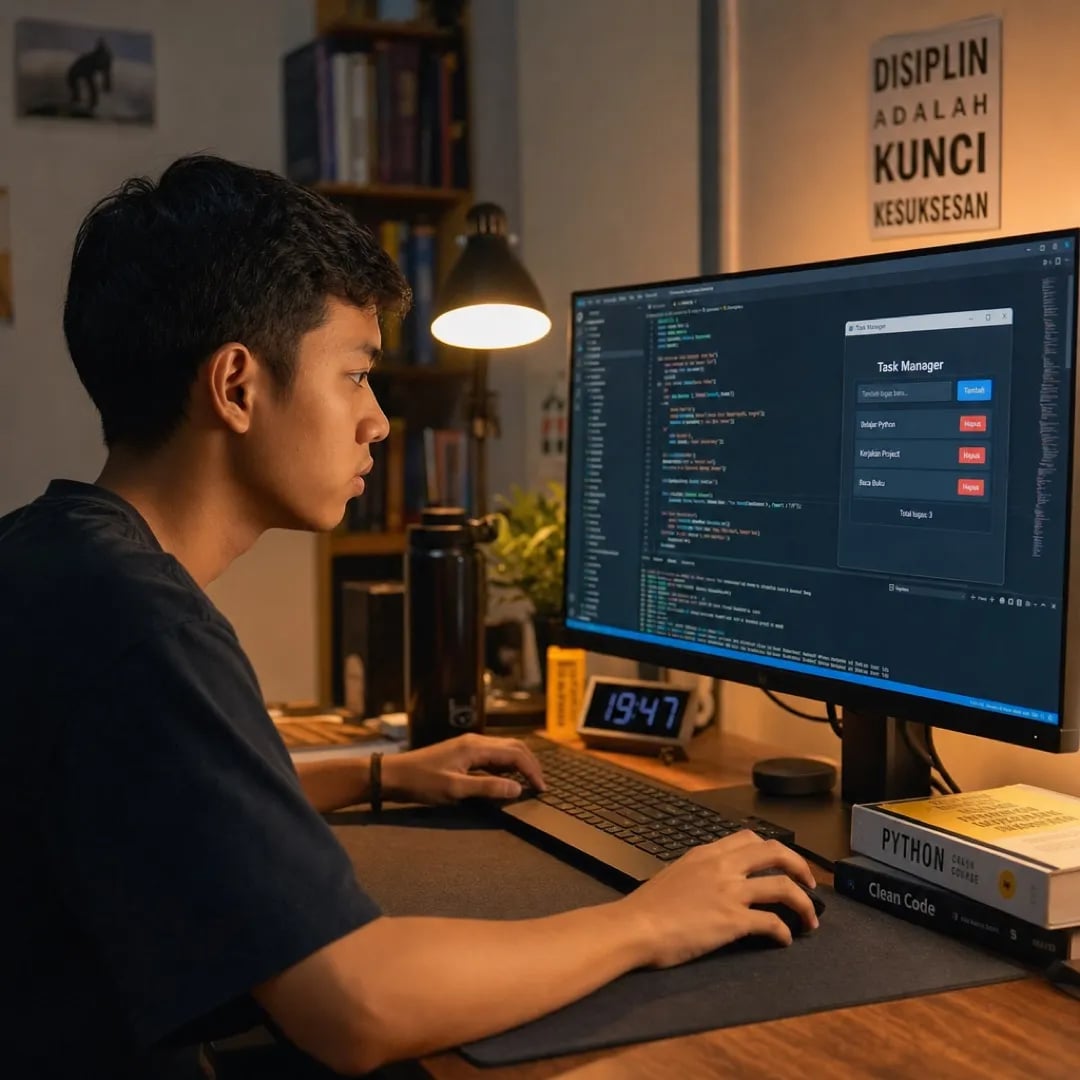
I joined because my mom made me. Stayed because by month 2 I’d built a quiz app my friends actually used. That was the first time a class felt real to me.

Raka Adityawan
Student, 15 · Jakarta

Teen Coders · Ages 12–17
Online programming for teens aged 12–17 at Algonova. Learn Python, AI tools, and deploy real websites — four courses (Python Start, AI, Python PRO, Frontend) for teen IT career preparation. A real portfolio that helps with university applications.
4 courses
for teens 12–17
Portfolio
by program end
32–41
lessons per course
Real tools
Python, Pandas, ML, JS, Figma
Program
Why now
From hobby to direction
The window is now
By 18, most teens have decided what they’re ‘good at’ and stopped exploring. Years 12–17 are the last easy chance to discover whether tech is the real calling — and start a head-start trajectory.
Real portfolio, not toy projects
Tangible output
Universities and first employers ask: ‘Show me something you built.’ By the end of Python PRO, teens have deployable web apps, working games, and 3–5 real projects on GitHub.
Habit of building
The underrated skill
Most teens consume — videos, games, content. Algonova students learn to build. That mental shift — from passive to maker — is the deepest thing we teach.
Algonova vs typical IT school
How it works
01
1. Diagnostic free class
We see what your teen already knows. Some have done a bit of Python; some have done nothing. The trial tells us which level to start at.
02
2. Personal trajectory
We don’t drop your teen into a generic group. They join a level that matches their starting point, with projects tilted toward their interests (games, web, data, design).
03
3. Real projects, every level
From level one, every module ends with a project the teen actually built. By Advanced, projects are deployable and shareable.
04
4. Portfolio handoff
By end of the program, your teen has a portfolio website with their projects. They keep it — for university apps, internships, or first freelance work.
Free 60-min diagnostic · Laptop required
Career prospects
Software & Web Developer
Most direct path
Build apps, websites, and services for companies or as a freelancer. Python (Start/PRO) and Frontend (HTML/CSS/JS) form this foundation. Many graduates start freelance work before university.
Data Analyst & ML Engineer
Fast-growing field
Analyze data with Pandas, train ML models. Python PRO (with ML + Pandas modules) builds the technical foundation. Particularly in demand in fintech, e-commerce, and data roles.
Game Developer & UI/UX Designer
Creative tech roles
Build games (Roblox + Game Design foundation) or design digital interfaces. Frontend course covers Figma, JavaScript, and design principles. A strong portfolio is essential — and our students graduate with one.
Teens and parents
I joined because my mom made me. Stayed because by month 2 I’d built a quiz app my friends actually used. That was the first time a class felt real to me.
Raka Adityawan
Student, 15 · Jakarta
My daughter applied to university with a portfolio website she built in Algonova. The admissions interview spent 10 minutes on her projects. That’s the kind of edge we wanted.

Farida Maulana
Mother of Tika, 17 · Bandung
Honest review: my son is in Python PRO and the work is hard. He’s struggled. He hasn’t quit. The teacher knows exactly when to push and when to ease off. That’s the value.

Endah Lestari
Mother of Yusuf, 16 · Tangerang
FAQ
Python Start (12–15) is the foundation if your teen wants to be a developer. AI (12–15) is great if they’re interested in creative tools and AI ethics. Frontend (16–17) requires some prior programming experience. The trial class helps us recommend the right starting course.
AI is a tool, not a replacement for understanding. Our AI course teaches how to USE AI tools effectively (14 of them), prompt engineering, AI ethics, and building real projects with AI. Plus a published portfolio website. These are skills employers actively look for in 2026.
Yes — many do. Common path: Python Start → AI → Python PRO → Frontend. Each course is 32–41 lessons (8–10 months). The result is a strong CV by university application time.
Indirectly, yes. Computational thinking helps with math and logic. More importantly, a real portfolio — deployed website, ML models, working apps — makes a big difference for teens applying to top universities.
Frontend ends with a live portfolio website. AI course produces a website with all AI projects. Python PRO produces working apps and ML projects. All published to GitHub. By 17, our students often have 5–10 real projects deployed online.
Software developer, web developer, data analyst, ML engineer, game developer, UI/UX designer, AI specialist. Many of our graduates start freelance during the program before university.
Yes, live online with a real teacher in small groups (4 in Premium, 7–10 in Group).
Packages personalized based on course, format (Private/Premium/Group), and length. Quote shared after the free trial class.

Algonova worldwide
Contact
Legal: legal@algonova.com
HR inquiries: hr@alg.team
Address
625 Orange Street, Suite 216A, Wilmington, DE, 19801
Algonova Global Inc © All rights reserved 2026
